The diplomatic action of the Holy See in the face of new global challenges

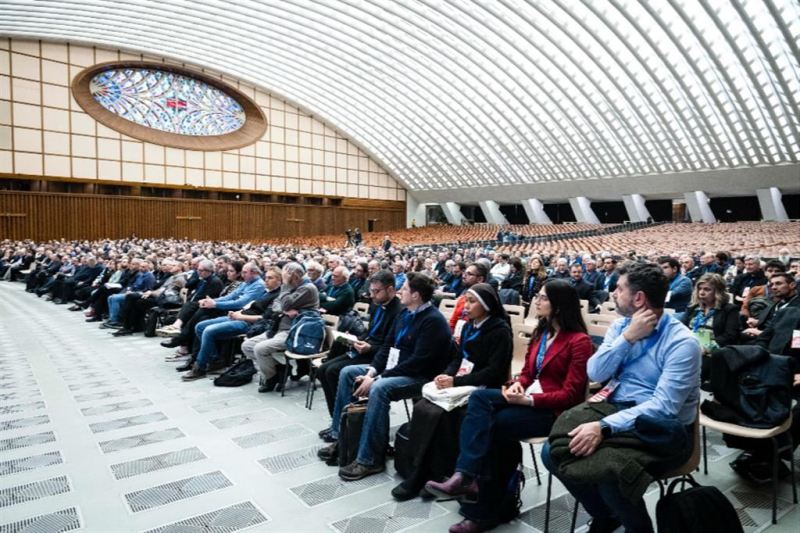
A Lectio magistralis by Cardinal Secretary of State Pietro Parolin opened the conference ‘The diplomatic action of the Holy See in the face of new global challenges’, organised by the Pontifical Ecclesiastical Academy: Peace and justice, voices that continue to rise in different regions of the planet as pillars of order among actions. The denunciation of the use of force to resolve conflicts, the need for solutions that are educational, formative and research-based. Diplomacy as a way to build the common good and, for those who work in the Holy See, the commitment to share people's pain and heal it with evangelical hope. These are some of the points that Cardinal Pietro Parolin highlights in his Lectio magistralis focused on ‘Peace and justice in the diplomacy of the Holy See in the face of new challenges.’ The Secretary of State spoke at this morning's conference, 17 January, in the Ducal Hall of the Apostolic Palace, on the occasion of the 325th anniversary of the founding of the Pontifical Ecclesiastical Academy.
Cardinal Parolin's key words were: "The prevailing multipolarism leads to armed peace or to the establishment of an attitude of mutual distrust between states. We need foresight and healthy realism to be peacemakers".
Secretary-General Michele Capasso emphasised the importance of the content of the letter that Pope Leone XIV sent to the participants and the words of hope that Cardinal Parolin addressed to the diplomats of the Holy See: I repeated to them a phrase that is dear to me and that has characterised our actions from the beginning: ‘Do much, say little’.
‘We find in Cardinal Parolin's Lectio,’ Secretary General Capasso told the press, "the expression according to the lesson of Pope Alexander VII "Do much, say little", when he hopes that “the Holy See's response will remain that of effective and discreet diplomacy, which sees in every level of activity and responsibility the possibility of seeking ways and means to ensure an international order based on justice, in which the principle and goal of coexistence is peace, operating according to the principles, customs and respect for the rules of diplomacy”.
This, Capasso concludes, ties in with the pastoral perspective referred to by Pope Leone XIV in his aforementioned letter: “The diplomatic service is not a profession, but a pastoral vocation: it is the evangelical art of encounter, which seeks paths of reconciliation where men raise walls and mistrust”.
This is the same path we have been following for forty years with the “United States of the World” and which we will continue to follow: “DO MUCH, SAY LITTLE”."

Continue reading

Condolences for Gino Nicolais

The ascent to heaven continues for friends who were members of the “United States of the World”: Mimmo Jodice, Claudio Azzolini, Francesco Paolo Casavola, Ornella Vanoni.
And today, the news of Luigi Nicolais, known to us all as “GINO”: a dear friend, from Vesuvius like so many of us, a great man of science and culture, but above all a gentleman and a man of honour who used politics – at every level he pursued it – as a means of affirming fundamental rights, including the right to education and scientific research.
The sadness of this moment is mitigated by the joy of having “surprised” him, as he liked to say.
On 3 June 2024, he spoke at a ceremony for the Mediterranean Awards and the appointment of the “Ambassadors of the United States of the World”. Present were personalities from various countries and representatives of international institutions, including the Director General of ICESCO, Salim AlMalik.
At the end of the ceremony, Gino did not expect that he would be the AMBASSADOR to be appointed: applause, recognition, but above all a great deal of affection, shown to Pia Molinari, the “author” of the surprise.
Thank you, dear Gino, for what you have given to all of us, especially at a difficult time in our history, marked by a famine of love and competence, which you have greatly reduced with your wisdom and your actions.

Continue reading

Italian Model United Nation

Two hundred students from various schools in Campania gathered at the headquarters of the “United States of the World” for the “Italian Model United Nations” meeting, organised by the United Network Association with the patronage of the “United States of the World” and in collaboration with the Mediterranean Foundation and the Museumon Peace MAMT.
On this occasion, Secretary-General Michele Capasso presented a preview of the “House for Peace” project.

Continue reading

Tribute to Shaykh Abd al-Wahid Pallavicini

Secretary-General Professor Michele Capasso paid tribute to the Italian Muslim master Abd-al-Wahid Pallavicini on the 75th anniversary of his conversion to Islam, following in the footsteps of René Guénon.
Seventy-five years after René Guénon's death, his work remains relevant even in the face of the upheavals that the world has undergone in recent decades.
René Guénon, Shaykh Abd al-Wahid Yahya, was a scholar who spent a lifetime of arduous intellectual struggle in the most diverse circles, aimed at dispelling the oblivion and corruption of spirituality that had taken root in the West, hoping for a rapprochement between East and West that would take place under the banner of common recognition of immutable and transcendent principles and on condition that the West took a step towards reorienting its perspective. From France, he moved permanently to Egypt where, without wanting to have disciples, he continued his work of intellectual renewal and appeal.
On 7 January seventy-five years ago, when René Guénon left this world, Shaykh Abd al-Wahid Pallavicini entered Islam. This Italian Muslim master honoured René Guénon's legacy by translating metaphysical principles, which many had forgotten, into traditional life practices, allowing those who had only read about them to live them. When there had been no Muslim community in Italy since the Middle Ages, he made it possible to draw on the spiritual source of the East, formed a community of disciples, and worked for the official recognition of Islam, also calling for the recognition of the common Abrahamic roots. In bearing witness to the Oneness of God, he reminded believers that they must help each other to recognise Him not as “one” in a numerical sense but as the only presence in the life of every community to which we are all called to return. This is the universal value of religions that Shaykh Abd al-Wahid transmitted.
As a summary of these 75 years, we are publishing a text by Shaykh Abd al-Wahid Pallavicini taken from his book “Islam Interiore. La ricerca della Verità nella religione islamica” (Inner Islam. The search for Truth in the Islamic religion), in which he clarifies the deeper meaning of the contribution that Islam can make to the renewal of the West.

Continue reading

A clap of hands for Franco Casavola

All of us founders of the UNITED STATES OF THE WORLD and the FONDAZIONE MEDITERRANEO express our deepest condolences and applaud the passing of Francesco Paolo Casavola, president emeritus of the Constitutional Court and member of our institution.
Franco was a dear friend of mine, whom I met through Francesco De Martino, whose assistant he was from 1955 onwards.
Our lives intertwined on many occasions: from our participation in the Arbitration Commission in the former Yugoslavia in 1993-94 to the drafting of the “Constitution of the United States of the World” on 12 December 1997. on that day, despite the presence of over two thousand delegates from many countries, we continued to talk about articles, democracy and bioethics, attracting the curiosity and attention of the then Prince Felipe of Spain (now King Felipe VI).
Among my many memories are two beautiful dedications in two of his books: “F. De Martino storico” (1990) and Return to the origins. For the reconstruction of the foundations of democracy (2014).
Upon hearing the news, there was a desire, almost a need, to hear his voice: on the very day that Trump violated Venezuela's sovereignty and the world continues to trample on every form of international law every day.
We did so by listening again to an interview Franco gave two years ago to Filippo Patroni Griffi, a constitutional judge, in which he reiterates the weakening of the value and collegiality of the High Court and the need to protect citizens' rights “however and wherever” through a “new rich humanity”.
His words should serve as a warning in this difficult period of history in which we are experiencing a daily famine of humanity, values and rights.

Continue reading